
Summary
Present throughout the country, La Poste Groupe is taking concrete action against climate change. Reducing greenhouse gas emissions, deploying low-carbon logistics in urban areas, and adapting activities to climate risks: its actions are part of a science-based trajectory and support local authorities, businesses and citizens in the ecological transition, in France and across Europe.
For more than twenty years, La Poste Groupe has been working to make its activities more environmentally sustainable. Faced with the urgency of climate change and planetary boundaries, this commitment is based on a comprehensive mitigation and adaptation policy deployed across all Group activities.
Mitigation
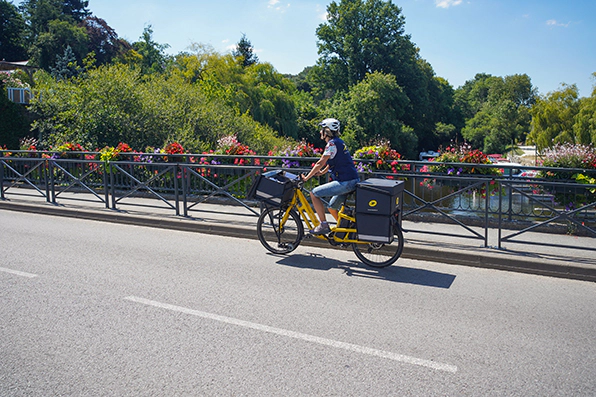
In 2025, the Group's greenhouse gas emissions decreased by 528,343 tonnes of CO₂ equivalent, representing a 9.6% reduction compared with 2024 (Scopes 1, 2 and 3). This reduction trend continues across all Group business units and is supported by : the development of low-carbon transport kilometres and continued optimisation of transport networks; increasing electrification of first- and last-mile fleets, both owned and subcontracted; faster deployment of new low-carbon transport solutions (biogas, biofuels and, in the medium term, hydrogen, among others); strengthened action to decarbonise the property portfolio through the deployment of Terseren projects, the joint venture established in 2024 by La Poste Immobilier and EDF.
Committed to transparency and to providing customers with reliable information, the Group promotes initiatives aimed at establishing a standard methodology for calculating parcel-level emissions. In addition, the Group measures emissions financed through its banking and insurance activities. In 2025, these amounted to 179.5 MtCO₂e (compared with 146.0 MtCO₂e in 2024) and are covered by a dedicated transition plan.
The greenhouse gas emissions reductions achieved by the Group in 2025 are aligned with the trajectory certified by the Science Based Targets initiative (SBTi). The Group's climate leadership was once again recognised in December 2025 by CDP, which included it on its A List (top 4% of nearly 20,000 companies).
Adaptation
The increasing frequency and intensity of extreme weather events expose the Group to damage and destruction affecting its buildings, with direct consequences for employees' working conditions.

In 2025, La Poste Groupe defined an initial adaptation plan, complementing its transition plan, to strengthen the resilience of its business model.
To build this adaptation plan, the Group assessed risks to its activities against the IPCC's severe +4°C warming scenario for 2100. Based on this scenario, the range of climate hazards was identified, including storms, floods, landslides and heatwaves. The Group evaluated the impacts of these hazards on buildings and their insurability, service continuity, customer services, and employee health and safety.
To address these climate risks, initial investments, aligned with mitigation efforts, have been made, including thermal renovation of buildings and green roofs. Pilot programmes had already been launched in 2024 to identify viable, scalable solutions adapted to local conditions, including adiabatic cooling systems for logistics platforms and mobile units, adapted clothing for employees, and shade netting.
Improving air quality
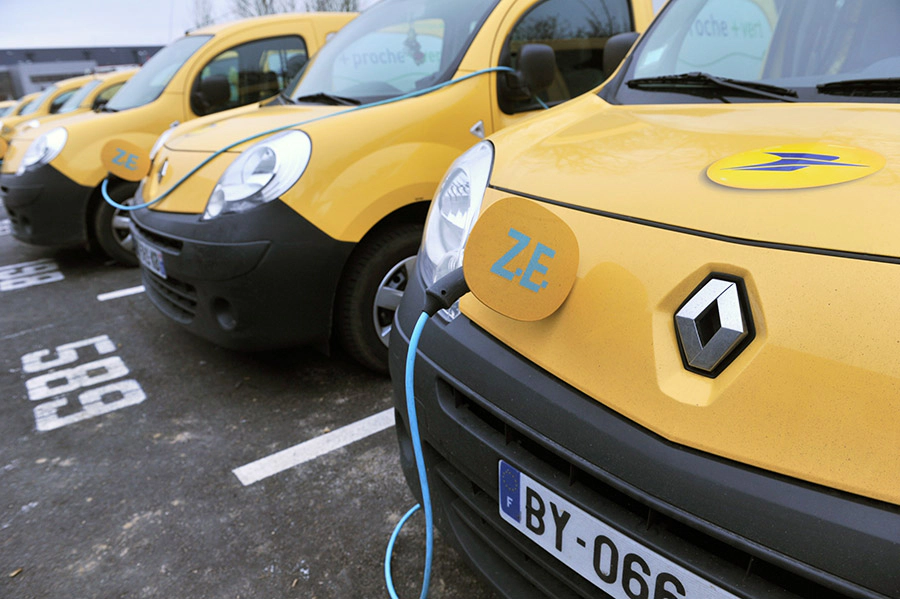
The ambition of La Poste Groupe is to manage and reduce local air pollutant emissions in line with its environmental objectives. In 2025, a common measurement protocol was formalised covering transport and logistics activities within the Services-Mail-Parcels business unit and Geopost (including subcontracting partners), as well as company and service vehicles. The Group was one of the first transport companies to define a trajectory and reduction targets for air pollutant emissions. This approach builds on the same levers deployed through its climate transition plan.
- 9.6%
Greenhouse gas emissions in 2025 vs. 2024
- 4.6 %
Greenhouse gas emissions per parcel in 2025 vs. 2024
- 45.3%
Air pollutant emissions since 2020
Questions - answers
What actions is La Poste Groupe taking to decarbonise its property portfolio?
La Poste Groupe is implementing a property portfolio decarbonisation programme aimed at improving building energy performance, reducing floor space and increasing the share of renewable energy. This trajectory is supported by investments exceeding €23 million and by electricity already sourced 90% from renewable energy, with a target of reducing emissions by 51,664 tonnes of CO₂ equivalent by 2030 (2024 baseline).
How is La Poste Groupe developing low-carbon long-distance transport?
By 2030, La Poste Groupe aims for 50% of long-distance transport kilometres to be low carbon. To achieve this, it is mobilising its transport and logistics businesses to decarbonise long-distance transport modes (fleet electrification, biogas, biofuels including HVO, hydrogen, etc.) and optimise logistics networks. In 2025, 19.2% of kilometres travelled by Services-Mail-Parcels vehicles were low carbon, and 18.4% for Geopost vehicles.
What impact do banking activities have on the Group's carbon trajectory?
La Poste Groupe measures the CO₂ emissions financed by its banking and insurance activities. In 2025, these amounted to 179.5 MtCO₂e (compared with 146.0 MtCO₂e in 2024) and are covered by a dedicated transition plan. La Banque Postale and CNP Assurances are working to decarbonise investments and support their customers' low-carbon transition.