
Urban logistics refers to all flows of goods that enter and leave a city, and circulate with it. For the most part, these flows are linked to BtoB ¹ (85 %) markets. However, in recent years, the growth of e-commerce has caused the volume of BtoC ² goods flows to explode. Consequently, for la Poste, the challenge in relation to e-commerce is to handle more and more parcels and goods that need be delivered or collected in cities, without increasing the emissions and disturbances due to this activity: congestion, noise, pollution, etc.
La Poste is rising to challenge of greener urban logistics
As a long-standing player in the sector, Le Groupe La Poste has made low-emission urban logistics a priority. Both in France and Europe, the Group's goal is to become a central cog in the distribution and delivery of carbon-free goods in urban areas.
Along with its various operators, brands and subsidiaries (the Services-Mail-Parcels branch, Colissimo, DPD France, Chronopost, Pickup, etc.), La Poste Groupe has risen to this challenge. In addition to taking effective action to reduce greenhouse gas (GHG) and pollutant emissions linked to its logistics activities, the Group is developing new locally-based services and mobilising all its stakeholders to co-construct the logistics solutions of the future.
The 4 key focus points involve :
Reducing the environmental impact of logistics activities
Since 2013, Le Groupe La Poste has been committed to decarbonising the transportation and delivery of goods in cities.
It is also actively working to better integrate its logistics activities into cities.
By optimising its delivery rounds, the Group can significantly reduce its greenhouse gas (GHG) emissions.
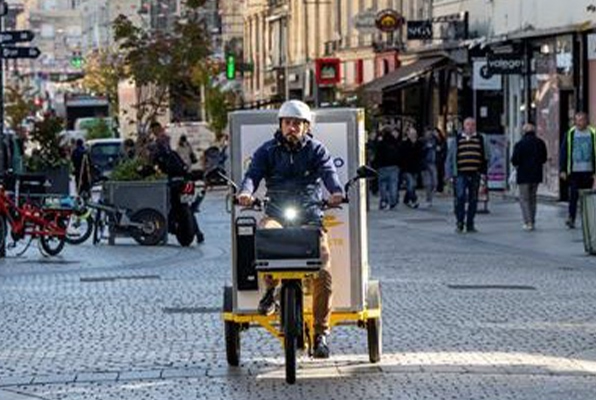
1. Developing local logistics
In view of the growing use of digital applications, and in response to consumers' expectations in terms of local, personalised services, La Poste is developing new logistics solutions to reduce the environmental impact of its operations.
Certain solutions have a direct impact on the level of C02 emissions by improving the percentage of parcels that are delivered at the first attempt. All of the solutions meet the expectations of urban dwellers, who wish to live, work and consume while limiting their need to travel.
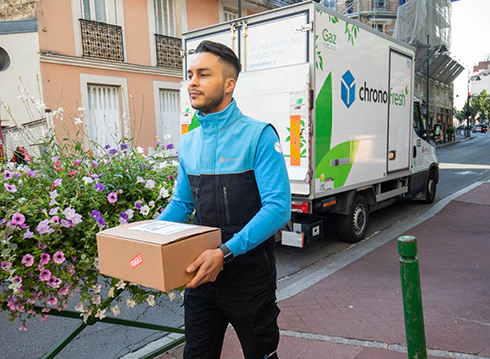
3. Co-developing solutions with local authorities
La Poste's collaboration with local authorities is crucial to achieving its emission reduction targets.
The group has established a dialogue with major cities in order to develop coordinated and synchronized action plans.
Several territories are involved in this initiative with La Poste and have adopted an action plan.
4. Working together with the logistics industry
Le groupe La Poste encourages the sharing of expertise in order to develop new responses to the environmental and operational challenges of urban logistics.
La Poste is working with industry professionals, public authorities, researchers, etc. to develop new solutions aimed at reducing traffic congestion and decarbonising cities.
These exchanges foster dialogue and lead to the development of more efficient urban logistics solutions on the ground.
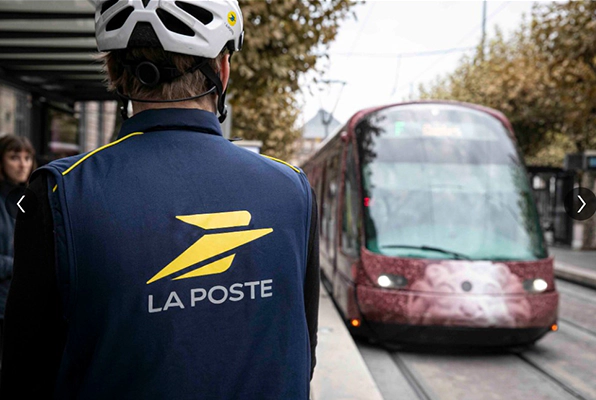
Parcel transport by tram in Strasbourg